

It is the policy of the tech college to operate under an open-door policy and serve all individuals on an equal opportunity basis. All persons who can gain from technical education shall have an opportunity to enroll in courses but not necessarily all programs.
The college is committed to providing equal educational opportunity regardless of gender, marital status or parental status, race, color, religion, age, national origin, or physical or mental disability, as required by Title VI and Title VII of the Civil Rights Act of 1964, Title IX of the Educational Amendment of 1972, Section 504 of the Rehabilitation Act of 1973, the Age Discrimination Act of 1975, the Vocational Amendments of 1976, and the Americans with Disabilities Act, and all other applicable state and federal laws (OTECH Policy 530.5 Student Non-Discrimination).
All concerns related to fair and equal treatment should now be directed to the Title IX Coordinator(s) at titleix@otech.edu.
Title IX Coordinator
Deputy Title IX Coodinator
Title IX is a federal law that prohibits sex discrimination and harassment in an educational setting. The college is committed to maintaining a learning environment free from abuse, intimidation, harassment and discrimination.
Covered offenses include sexual harassment, sexual assault, domestic and dating violence, stalking, and sex discrimination.
Read the Department of Education’s Information on Title IX.
If you have questions about Title IX, please contact the Title IX Coordinator(s) at titleix@otech.edu.
Title IX Coordinator
Deputy Title IX Coodinator
Any person may report sex discrimination, including sexual harassment (whether or not the person reporting is the person alleged to be the victim of conduct that could constitute sex discrimination or sexual harassment), in person, by mail, by telephone, or by electronic mail, using the contact information listed for the Title IX Coordinator below, or the link below. Such a report may be made at any time.
Once a complaint has been received, the Title IX Coordinator or designee will meet with the person who submitted the complaint to gather more information. If it is determined that the College has jurisdiction, and it is a covered offense, the complainant will have the opportunity to decide to file a formal complaint. Once a formal complaint is received, an investigator will be assigned.
Each party has the right to have an advisor present or involved during the process of the investigation. If a student does not have an advisor of their choice, the College will provide an advisor when the process reaches the hearing/resolution stage.
The investigator will attempt to interview the complainant, the respondent and any appropriate witnesses who are identified. The investigator will compile all of the relevant evidence into an investigative report. The report will be sent to the parties for review. The parties will have up to 10 days to review the report and submit additional information or pose questions they would like the investigator to ask the other party.
Once feedback has been received and any additional information has been included, the investigator will finalize the report and send it to the parties again. The parties will have at least 10 days to review the final report in preparation for a resolution process.
If both parties agree, the resolution process can be informal, as long as all parties are comfortable with the resolution.
Both parties have the right to a formal hearing. At a formal hearing, the parties have the opportunity to have an advisor cross examine the other party on their behalf. The hearing will be facilitated by a hearing officer. After the hearing, the hearing officer will render a decision whether or not the allegation is supported by the preponderance of the evidence (more likely than not that the offense happened). Once a decision has been made, a panel will determine the appropriate sanctions or remedies to stop, prevent, and remedy the behavior.
The college will make every effort to accomplish these steps in a reasonable amount of time.
Title IX Coordinator
Deputy Title IX Coodinator
A complaint can be filed using any of these options:
Email
titleix@otech.edu
801-627-8321
Submit online
File a complaint
Suicide Hotline: 801-625-3700
YCC Rape/Domestic Violence Crisis Line: 801-392-7273
Domestic Violence Information Line: 1-800-897-5465 or 1-800-799-7233
DCFS Child Abuse Reporting Line: 1-855-323-3237
Sexual Assault Crisis Line: 1-888-421-1100
Ogden Weber Technical College Student Support Specialists Team: 801-627-8300
Northern Utah SANE (forensic nurses for sexual assault exams): 1-888-328-3605
Pregnant students, students who give birth, or who had a pregnancy end may be entitled to accommodations under Title IX. These are not accommodations allowing for parenting time, they are medical accommodations because pregnancy is considered a short-term disability. Accommodations may include excused absences for pregnancy or birth related matters, coursework modification, and assurance your funding and course progress remains intact during absences related to pregnancy. Accommodations may require documentation and must be arranged through the Title IX Coordinator(s) to be guaranteed.
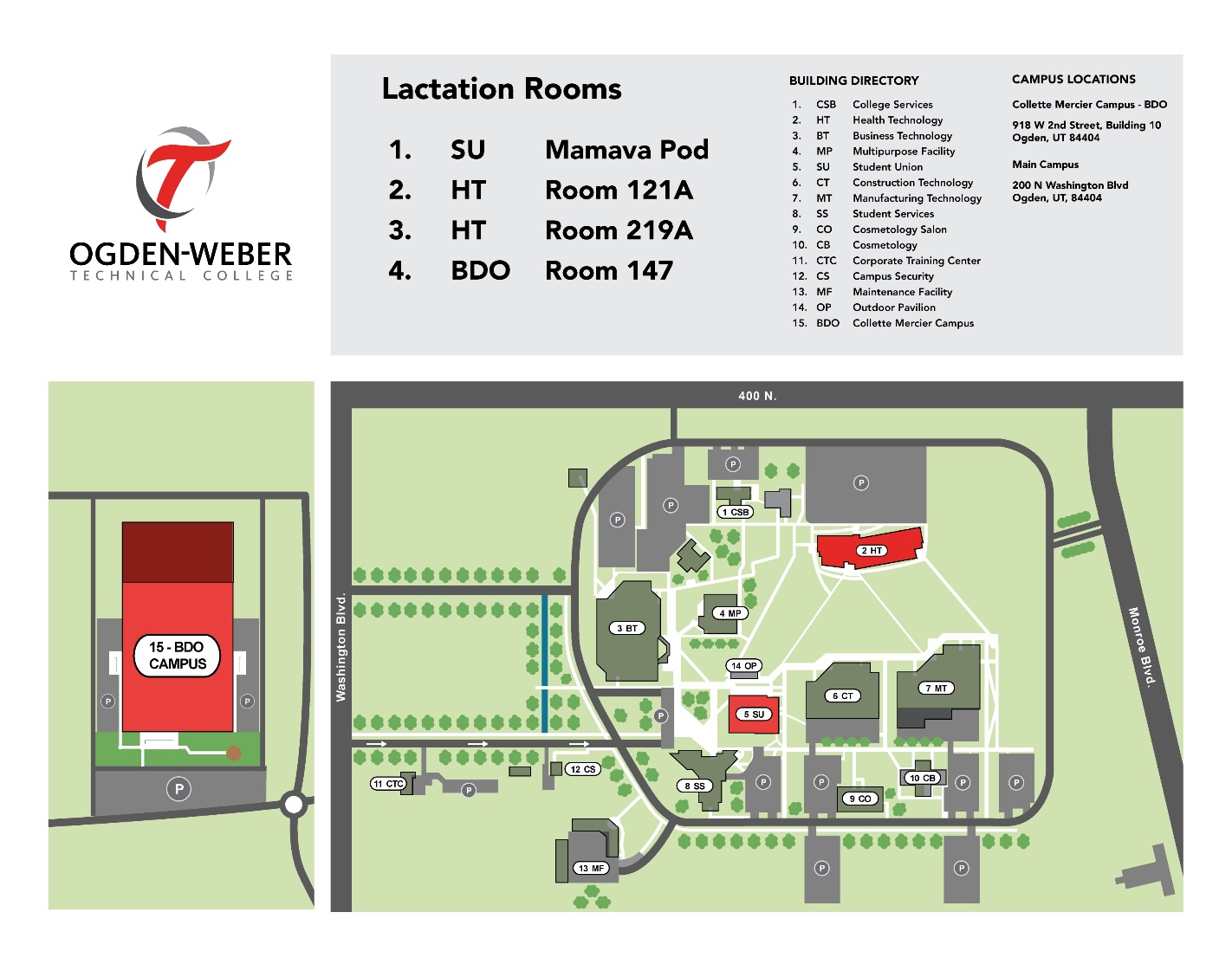
Ogden-Weber Technical College has lactation spaces available on both campuses! Review the map below or open the map here to see which location is nearest to you, and for questions about lactation spaces, please contact the Title IX Coordinator(s).
Lactation Rooms
Ogden-Weber Technical College provides designated lactation spaces on both campuses to support nursing individuals. Please refer to the map below to find the location most convenient for you.
For questions or additional information about lactation spaces, contact the Title IX Coordinator.
Child Care Assistance
The Utah Department of Workforce Services (DWS) offers Child Care Assistance for low-income parents. Learn more about eligibility requirements and how to apply for this childcare subsidy.
https://jobs.utah.gov/occ/parent/overview.html
Utah Women, Infants and Children
The Women, Infants and Children (WIC) program provides nutritional information, breastfeeding services, and supplemental food to Utah families in need. Food is available for parents during and after pregnancy and for children up to 5 years old.
https://wic.utah.gov/
Baby Your Baby
Baby Your Baby is another Medicaid program that covers pregnancy – related outpatient medical care for low-income parents. It does not cover deliver of the baby.
https://babyyourbaby.org/
United Way – Northern Utah
Welcome Baby is a free program for families with children from birth to 36 months. Each month a trained volunteer visits your home with diapers, wipes, clothes, books, and tools to support your child’s development. No income requirements.
https://uwnu.org/ourprograms/welcome-baby/welcomebaby.html
Utah Parent Center
Is dedicated to helping parents assist their children, youth and young adults with disabilities and special healthcare needs to lead inclusive, productive lives within the community.
https://utahparentcenter.org/
OWCAP
Odgen-Weber Community Action Partnership promotes school readiness of children ages birth to 5 from low-income families.
https://www.owcap.org/headstart/
Title IX Accommodations for Pregnant and Postpartum Students
Students who are pregnant, have given birth, or experienced a pregnancy loss may be eligible for accommodations under Title IX. These accommodations are not intended for parenting time, but rather are medical in nature, as pregnancy is recognized as a temporary disability.
Eligible accommodations may include:
If a certification’s title has a link, you can follow the link to be taken to its training materials. If you would like to review the other certifications’ training materials, you can request them by contacting the Title IX Coordinator at title.ix@otech.edu or 801-627-8321.
Training Materials
Title IX Training for Presidents
Annual USHE Title IX Training August 2024